


Research is the backbone of effective public health strategy. CAPED is currently driving two major initiatives to improve screening methodologies:
-
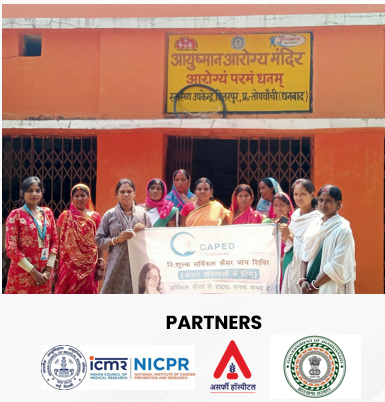
- Piloting HPV Extended Genotyping Primary Screening to Support Accelerated Cervical Cancer Elimination in Jharkhand : A 12-month implementation study is ongoing in Dhanbad district through a cross-sector partnership involving the Government of Jharkhand, Cancer Awareness, Prevention and Early Detection (CAPED) Trust, Becton Dickinson & Co., ICMR–National Institute of Cancer Prevention and Research (NICPR), and a tertiary care hospital (Asarfi Hospital). The study aims to screen 8,000 women using both self-sampling and healthcare provider-collected samples, helping expand access to cervical cancer screening and generate evidence for more effective screening approaches. Together with ongoing field studies, this work reflects the importance of generating evidence that supports stronger public health decision-making.
- ICMR Intramural Project :Assessing reach and effectiveness of primary HPV-DNA-based vs visual inspection methods for scalability and sustainability of cervical cancer screening in community-based settings in Delhi : An Implementation Research : Serving as a mobilization partner alongside ICMR-NICPR, we are evaluating VIA and HPV-DNA testing for 3,000 women.
- PRAVAAH : A Patient Tracking Pathway Platform for the Continuum of Cancer Care (PRAVAAH: Pathway, Referral, Adherence, Visibility, Access, and Accountable Healthcare
Objective : To strengthen continuity of cancer care by transforming existing NPNCD Portal data into a longitudinal patient pathway view that enables real-time tracking, identification of care gaps, timely follow-up, and evidence-based programme management across the cancer care continuum
Description: PRAVAAH is being developed by the Indian Institute of Technology Delhi in collaboration with Cancer Awareness, Prevention and Early Detection (CAPED India) to strengthen cancer care pathways using existing data from ) the National Programme for Prevention and Control of Non Communicable Diseases (NPNCD) Portal . Rather than creating a new portal or parallel reporting system, PRAVAAH reorganises existing programme data into a longitudinal patient pathway view, enabling programme managers to monitor patient progression across the cancer care continuum